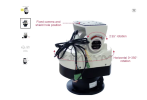
I'm trying to build a pan‑tilt sat dish for a campervan using a - Metal Load RS485 Motorized Pan Tilt Scanner Decoder Preset PTZ Horizontal Vertical Rotate for Outdoor CCTV Camera Support
I originally assumed the motors were standard two‑wire DC, but when I opened it up I found each motor actually has four wires. Each pair measures about 3.5 Ω, so it looks like a two‑coil DC arrangement rather than a simple two‑wire motor.
I’ve already had the unit running through Pelco P on a Raspberry Pi, and that part works exactly how I want it to. The only issue is the motors run too fast. My plan has always been to keep Pelco P for positioning and use an L298 purely to slow the motors down . The four‑wire setup is the only thing complicating it.
Most searches for “four‑wire DC motor” just point to stepper motors which isn’t helpful . In the video I originally looked at, the guy built his own control board, but he only shows a quick glimpse of it and he’s not using Pelco at all — looks like he’s driving it from something like an Arduino — so that doesn’t really apply to what I’m doing.
Here the link to his teardown
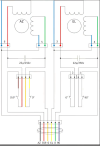
And a brief shot of his diagram
What I need to figure out is the simplest way to slow these motors down . I’m trying to work out whether the L298 will handle this properly with these two‑coil motors, or whether I should just use some kind of current/voltage‑limiting method — resistors, a potentiometer, something along those lines — to bring the speed down between the pelco board and the motors, is it possible?
If anyone’s dealt with these four‑wire DC motors or has a clean way to reduce the speed while keeping Pelco Protocol, the unit is well made, good motors , nice movement , all metal and worm drives, so will handle a dish fine, just a bit fast. , I’d appreciate the advice,.
I originally assumed the motors were standard two‑wire DC, but when I opened it up I found each motor actually has four wires. Each pair measures about 3.5 Ω, so it looks like a two‑coil DC arrangement rather than a simple two‑wire motor.
I’ve already had the unit running through Pelco P on a Raspberry Pi, and that part works exactly how I want it to. The only issue is the motors run too fast. My plan has always been to keep Pelco P for positioning and use an L298 purely to slow the motors down . The four‑wire setup is the only thing complicating it.
Most searches for “four‑wire DC motor” just point to stepper motors which isn’t helpful . In the video I originally looked at, the guy built his own control board, but he only shows a quick glimpse of it and he’s not using Pelco at all — looks like he’s driving it from something like an Arduino — so that doesn’t really apply to what I’m doing.
Here the link to his teardown
And a brief shot of his diagram
What I need to figure out is the simplest way to slow these motors down . I’m trying to work out whether the L298 will handle this properly with these two‑coil motors, or whether I should just use some kind of current/voltage‑limiting method — resistors, a potentiometer, something along those lines — to bring the speed down between the pelco board and the motors, is it possible?
If anyone’s dealt with these four‑wire DC motors or has a clean way to reduce the speed while keeping Pelco Protocol, the unit is well made, good motors , nice movement , all metal and worm drives, so will handle a dish fine, just a bit fast. , I’d appreciate the advice,.